[在此输入人物名称]

身份角色:[皇帝 / 苏丹 / 可汗 / 名将 / 指挥官 / 军阀 / 军事谋略家 / 统治者]
历史时期:[朝代 / 帝国 / 历史阶段]
文化/地域:[中国 / 奥斯曼 / 日本 / 蒙古 / 波斯 / 罗马 / 拜占庭 / 突厥 / 韩国 / 印度 / 阿拉伯 / 欧洲等]
标志性配饰或武器:[青龙偃月刀 / 长矛 / 弓 / 剑 / 锤 / 旗帜 / 玺印 / 卷轴 / 法杖 / 长柄斧 / 盾牌等]
核心关键词:[统一 / 改革 / 征服 / 忠诚 / 策略 / 正义 / 扩张 / 黄金时代 / 抵抗 / 治国之道等]
主色调:[神秘黑金红 / 蔚蓝金 / 墨色深红金 / 钢甲深蓝 / 翡翠青铜 / 绯红黑金等]
纵横比:3:4 纵向

请按照 3:4 比例创作一张高端、高保真的历史传记海报。

语言规则:
海报中所有可见文本必须仅使用英文。严禁使用中文、土耳其语、阿拉伯语、日语、韩语、希腊语或任何其他非英语语言。所有标题、事件名称、时间轴标签、描述、印章、注释和装饰性文字必须以清晰易读的英文书写。如果需要历史感的装饰性文字,请仅使用抽象且不可读的纹理,不得使用真实的外国文字。仅使用英文排版。

这并非普通的海报,而是一张电影化的档案传记构图,结构为:
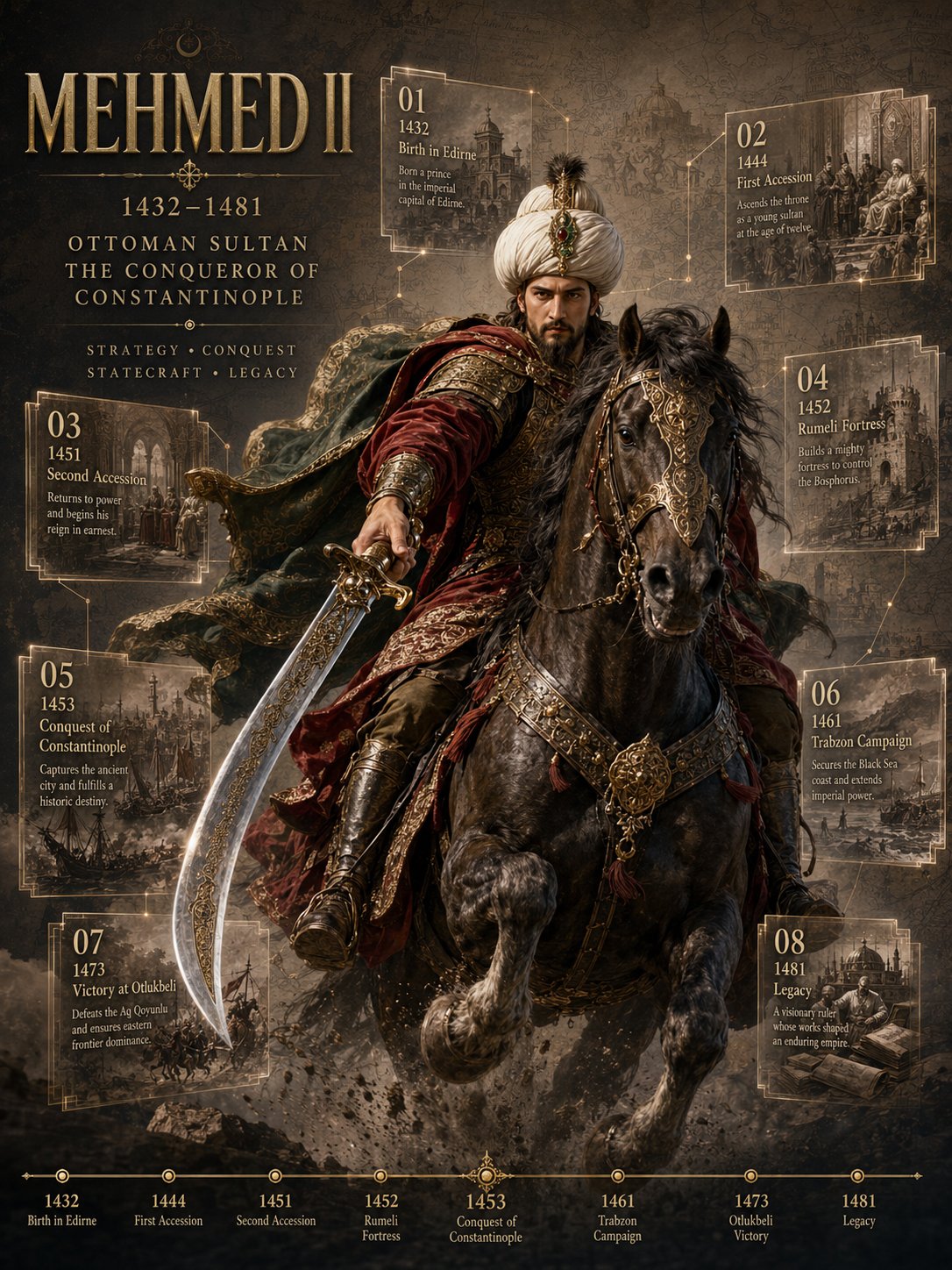
“中央全身骑马历史人物 + 向前冲击的突破性动作 + 悬浮的历史事件簇 + 极简编年时间轴”

主要目标:
将 [历史人物] 描绘成一个强大的骑马历史偶像。人物必须骑在马上作为构图的绝对中心,手持或展示 [标志性配饰或武器]。盔甲、服饰、马具和象征性细节必须严格匹配 [历史时期] 和 [文化/地域]。

核心人物:
主体必须是全身骑马人物,具有极强的雕塑体量感。骑马姿态必须包含强烈的前冲突破动作:马匹正在奔袭,骑手向观众延伸 [标志性配饰或武器],利用近大远小的透视夸张创造深度与视觉冲击力。表情威严,细节精细。

马匹设计:
马匹应展现出力量感与高贵气质,配色需符合整体调色盘,配有符合时代的马具与装饰。

悬浮历史事件簇:
在人物周围放置 6 到 10 个轻盈的档案碎片或半透明玻璃面板。每个节点包含事件编号、年份、简短英文标题、极简英文描述以及低饱和度的场景剪影。空间分布错落有致,营造出博物馆档案的质感。

标题与时间轴:
海报左侧包含大号英文名称、生卒年及核心关键词摘要。底部设有一条极简的金色细线时间轴,连接主要生命节点。整体风格追求博物馆级别的专业感。

视觉层级:
1. 中央骑马人物(核心焦点)
2. 冲击动作与武器(视觉深度)
3. 悬浮事件碎片(信息层)
4. 底部时间轴(辅助引导)
5. 档案感背景(质感烘托)

风格品质:超细腻历史写实、高端电影主视觉、3D 精炼纹理、戏剧化光影、高清晰度印刷品质。
[User Input]
Subject Figure: [write a name]

Identity Role: [Emperor / Sultan / Khan / Famous General / Commander / Warlord / Military Strategist / Ruler]
Historical Era: [Dynasty / Empire / Historical Period]
Culture / Region: [Chinese / Ottoman / Japanese / Mongol / Persian / Roman / Byzantine / Turkic / Korean / Indian / Arab / European, etc.]
Signature Accessory or Weapon: [guandao / spear / bow / sword / mace / banner / imperial seal / scroll / staff / halberd / shield, etc.]
Core Keywords: [Unification / Reform / Conquest / Loyalty / Strategy / Justice / Expansion / Golden Age / Resistance / Statecraft, etc.]
Main Color Palette: [Mystical Black Gold Red / Azure Blue Gold / Ink Dark Red Gold / Steel Armor Deep Blue / Emerald Bronze / Crimson Black Gold, etc.]
Aspect Ratio: 3:4 Portrait

Create a premium high-fidelity historical biography poster in exact 3:4 portrait format.

LANGUAGE RULE:
All visible text in the final poster must be in English only.
Do NOT use Turkish, Chinese, Arabic, Latin phrases, Ottoman script, Japanese, Korean, Greek, or any other language in the final image.
All titles, event names, timeline labels, descriptions, seals, annotations, maps, and decorative text must be written only in clean, readable English.
If historical decorative writing is needed, use abstract unreadable texture only, not real foreign-language text.
Use English typography only.

This is not a standard historical poster.
It is a cinematic archival biography composition built around this structure:

“Central Full-Body Horseback Historical Figure + Forward-Rushing Breakout Action + Floating Historical Event Clusters + Minimal Chronological Timeline”

MAIN GOAL:
Depict [Subject Figure] as a powerful horseback historical icon.
The figure must be riding a horse as the absolute center of the composition, holding or presenting [Signature Accessory or Weapon].
The object, costume, horse equipment, armor, headwear, and all symbolic details must strictly match [Historical Era] and [Culture / Region].

CENTRAL FIGURE:
The main subject must be a full-body mounted historical figure on horseback, shown as the dominant focal point.

Requirements:
- full-body figure clearly visible
- horse also clearly visible and integrated into the composition
- strong sculptural volume
- realistic anatomy
- cinematic lighting
- monumental presence
- premium 3D historical realism
- powerful facial expression
- dynamic windswept fabrics, hair, tassels, ribbons, or cloak elements if historically appropriate

The figure must NOT feel static.

The mounted figure must perform a strong forward-rushing breakout action:
- the horse should appear in motion, advancing toward the viewer
- one front leg may be lifted or stepping forward with force
- the rider must extend [Signature Accessory or Weapon] toward the viewer in a dramatic perspective
- near-large / far-small perspective distortion is required
- the composition must create depth, speed, and impact
- the extended object must be fully visible and must not be cropped
- the horse and rider should feel like they are breaking out of the poster plane

Historical styling must be accurate:
- correct armor, robes, uniforms, or ceremonial garments
- correct headwear, crown, helmet, turban, hat, or symbolic status item
- correct saddle, reins, horse ornamentation, and military/equestrian gear
- correct materials, motifs, decorative language, and cultural symbols for [Culture / Region]
- if the subject is a ruler, include subtle imperial dignity
- if the subject is a general, emphasize battlefield authority and martial power

HORSE DESIGN:
The horse is not secondary; it must feel noble, heroic, and historically integrated.

Horse requirements:
- anatomically strong and elegant
- color appropriate to the palette and subject identity
- historically appropriate tack and ornaments
- dynamic forward motion
- intense presence
- premium detail in mane, leatherwork, metal fittings, saddle, reins, and decorative elements
- horse must reinforce the identity and status of the rider

SURROUNDING HISTORICAL EVENT CLUSTERS:
Place 6 to 10 key historical nodes around the central mounted figure.

These must NOT look like heavy infographic cards.

Instead, they should appear as:
- lightweight floating archival fragments
- semi-transparent glass-like panels
- softly glowing edges
- open or incomplete borders
- layered in different depths and angles
- visually light compared to the central figure

Each node may include:
- event number
- year
- short English event title
- very short English description
- small monochrome or low-saturation scene fragments
- symbols, banners, architecture, battle moments, maps, cultural motifs, or artifacts related to the event
- thin gold lines, dots, annotations, or curator-style notes

Spatial rules:
- vary placement left and right of the figure
- vary tilt and perspective
- some nodes may overlap slightly
- some nodes may be partially hidden behind the rider, horse, or weapon
- maintain a floating museum-archive feeling, not a modern UI dashboard

LEFT SIDE TITLE AREA:
On the left side, create a clean title area.

Include:
- Large title: [Subject Figure] in English only
- Typography style: historically appropriate, engraved, imperial, calligraphic, or museum-like, but English alphabet only
- birth and death years if applicable
- Identity Role in English
- concise English keyword summary based on [Core Keywords]

This area must feel elegant, stable, and not overcrowded.

BOTTOM TIMELINE:
At the bottom, create a thin elegant chronological timeline.

Requirements:
- visually minimal and secondary
- thin gold or subtle glowing line
- small dots or markers for key years
- short English labels only
- connect major life events and surrounding nodes
- no heavy bars or blocks
- must feel like a museum curator’s timeline

BACKGROUND:
Use a restrained, low-saturation archival historical background.

Possible elements:
- aged manuscript paper
- rice paper texture
- museum wall tone
- faded maps
- ancient document fragments
- architectural silhouettes
- official seals and stamps
- faint abstract annotation marks
- subtle gold connecting lines

Important:
Any decorative writing in the background must be abstract and unreadable.
Do NOT include readable non-English text anywhere.

Overall feeling:
Clean, academic, archival, cinematic, and museum-like.

VISUAL HIERARCHY:
1. Central mounted historical figure = strongest and heaviest element
2. Forward-rushing action and extended object = second strongest
3. Floating event clusters = light and archival
4. Bottom timeline = minimal and secondary
5. Background = soft and restrained

STYLE & QUALITY:
- ultra-detailed historical fantasy realism
- premium cinematic key art
- museum-grade biography poster design
- polished 3D realism
- dramatic but controlled lighting
- refined texture work
- elegant composition
- strong depth
- high clarity
- print-quality finish

PRIORITY RULES:
If conflicts occur, prioritize in this order:
1. Full mounted figure and horse must remain complete and dominant
2. The period-accurate accessory / weapon must remain fully visible
3. Forward-rushing breakout action must be preserved
4. Floating event clusters must remain light and non-heavy
5. Timeline must remain minimal and unobtrusive
6. Background must remain subtle
7. English-only visible text is mandatory; no other language may appear anywhere in the image

TEXT SIMPLIFICATION RULE:
If text density becomes too complex:
- prioritize name, years, event numbers, and short English event titles
- simplify or reduce long descriptions
- maintain visual clarity over textual completeness
- never switch to any language other than English

Final result:
A majestic 3:4 historical biography poster showing [Subject Figure] on horseback in a powerful forward-rushing pose, wielding [Signature Accessory or Weapon], surrounded by elegant floating historical event fragments, with a refined English-only title area and minimal English-only bottom timeline, all rendered in a historically accurate, cinematic, premium archival style.