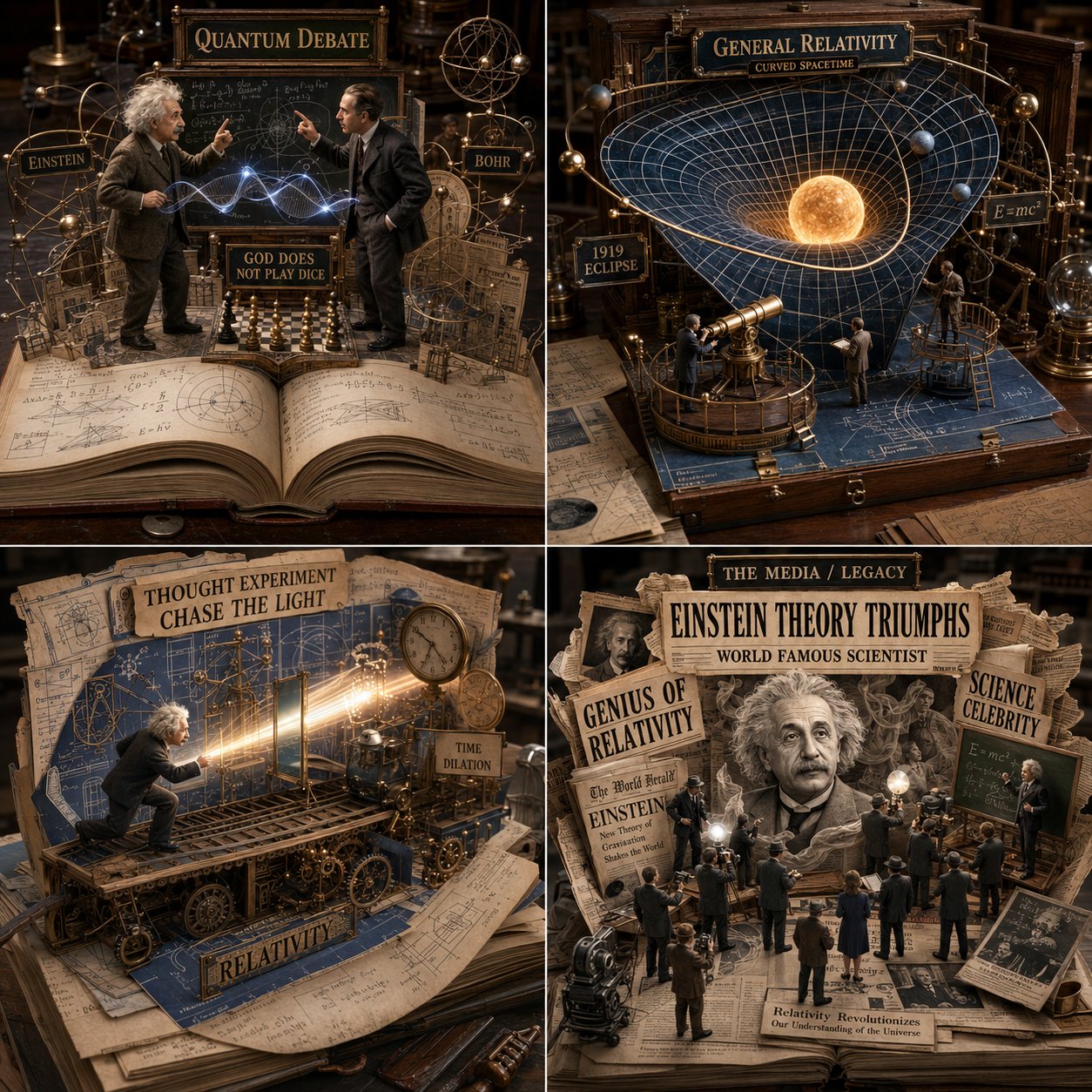
Einstein:

输入变量:[插入主题](例如:尼古拉·特斯拉、莱特兄弟、曼哈顿计划、列奥纳多·达·芬奇)

系统指令:
生成一组超写实的 2x2 宫格 3D 微缩景观。利用以下逻辑程序化生成输入主题历史的 4 个不同篇章:

1. 叙事划分(4个篇章):
分析输入变量并生成 4 个不同的视觉叙事:
- 板块 1(竞争):识别最大的冲突。(例如:特斯拉 vs 爱迪生;达芬奇 vs 米开朗基罗)。
- 板块 2(杰作):识别最具视觉冲击力或标志性的发明/创作。(例如:特斯拉塔;维特鲁威人)。
- 板块 3(神话/实验):识别一个被神话或“冷门”的故事。(例如:地震机;飞行器)。
- 板块 4(媒体/遗产):识别公众对他们的看法(例如:报纸头条、宣传、武器化)。

2. 容器(关键):
切记:4个板块不要使用相同的底座。底座必须与板块的叙事相匹配。
- 若为理论/竞争:使用打开的技术书籍或蓝图,人物站在纸面上。
- 若为发明/硬件:使用复古收音机、木柜或机器底座作为舞台。
- 若为媒体/新闻:使用堆叠的复古报纸,并带有清晰可读的标题。

3. 微缩景观:
- 过渡效果:2D 物体(书籍/纸张)物理性地喷薄而出转化为 3D。(例如:蓝图线条变为黄铜线;报纸照片变为 3D 烟雾)。
- 人物:1:12 比例的写实微缩模型。人物并非静止,而是在工作、争论或操作机器。
- 比例:发明物应高耸于人物之上,以展现其规模感和宏大感。

4. 视觉细节:
- 环境文本:场景必须包含环境中可读的标签。
- 名牌:如“交流电 - 特斯拉” vs “直流电 - 爱迪生”。
- 头条:如“神秘震动震撼实验室!”
- 动态元素:场景是鲜活的。能量(特斯拉线圈)、激光束、蒸汽或火焰必须渲染为体积光。动态效果包括碎片落下、齿轮转动等。

5. 灯光:
- 风格:“博物馆桌面”摄影风格。背景为温暖、丰富的木纹色调。
- 光影:微缩模型上的定向聚光灯,在书籍/蓝图上投射出戏剧性的阴影。
- 材质:高保真木材、黄铜、纸张和玻璃纹理。

输出:2x2 宫格,1:1 宽高比,Octane 渲染,历史频道美学,8k 分辨率。
Einstein :   Input Variable:   [INSERT TOPIC] (e.g., Nikola Tesla, The Wright Brothers, The Manhattan Project, Leonardo da Vinci)

  System Instruction:
Generate a hyper-realistic, 2x2 Grid of   3D Miniature Dioramas  . Use the following logic to procedurally generate 4 distinct chapters of the Input Variable's history:

  1.  Narrative Partitioning (The 4 Chapters):
Analyze the Input Variable and generate 4 distinct visual narratives:
      Panel 1 (The Rivalry):   Identify the biggest conflict. (e.g., Tesla vs. Edison; Da Vinci vs. Michelangelo).
      Panel 2 (The Magnum Opus):   Identify the most visual/iconic invention or creation. (e.g., Tesla Tower; The Vitruvian Man).
      Panel 3 (The Myth/Experiment):   Identify a sensationalized or "Deep Cut" story. (e.g., The Earthquake Machine; The Flying Machine).
      Panel 4 (The Media/Legacy):   Identify how the public viewed them (e.g., Newspaper Headlines, Propaganda, Weaponization).

  2.   Container
  CRITICAL:   Do not use the same base for all 4. The base must match the narrative of the panel.
     If Theory/Rivalry:  Use an   Open Technical Book   or   Blueprints  . The figures stand on the paper.
     If Invention/Hardware:  Use a   Vintage Radio  ,   Wooden Cabinet  , or   Machine Chassis   as the stage.
     If Media/News:  Use a stack of   Vintage Newspapers   with legible headlines.

  3. The Diorama
      The Transition:   The 2D object (Book/Paper) physically erupts into 3D.
         (e.g., Blueprint lines turn into Brass Wires; Newspaper photos turn into 3D smoke).
      The Figures:     1:12 Scale Photorealistic Miniatures.   They are not static; they are working, arguing, or operating machinery.
      The Scale:   The invention should tower over the figures to show scale and grandeur.

  4. Visual  (The Details):
      Diegetic Text:   The scene must include readable labels in the environment.
         Nameplates:  "AC POWER - TESLA" vs "DC POWER - EDISON".
         Headlines:  "MYSTERIOUS TREMOR SHAKES LAB!"
      Active Elements:   The scene is alive.
         Energy:  Electrical arcs (Tesla coils), Laser beams, Steam, or Fire must be rendered as   Volumetric Light  .
         Motion:  Debris falling, gears spinning.

  5. Lighting
      Style:     "Museum Tabletop" Photography.   Warm, rich wood tones in the background.
      Lighting:   Directed Spotlights on the miniatures, creating dramatic shadows on the books/blueprints.
      Material:   High-fidelity Wood, Brass, Paper, and Glass textures.

  Output:   2x2 Grid, 1:1 Aspect Ratio, Octane Render, "History Channel" Aesthetic, 8k Resolution.